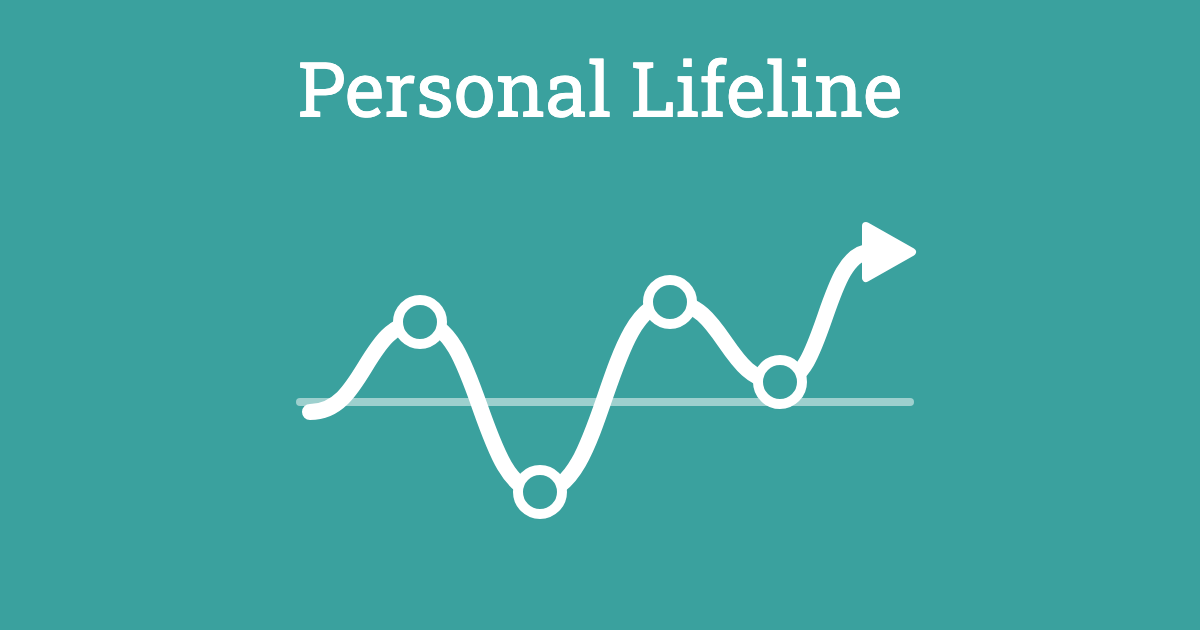
In a Personal Lifeline, each person draws a single line across a large sheet of paper to show the high and low points of their career, or of a chosen part of their life. Peaks are times when things went well, and dips are times that were hard. Labelling the moments and then looking at the shape as a whole often reveals surprising patterns about what helps people thrive.
It’s a good fit for leadership, coaching and career development workshops, and for teams who already have some trust and want to understand each other better. It asks people to think about personal experiences, so it isn’t one for a group that has only just met. For a lighter way to get to know each other, try Two Truths and a Lie.
Method
Agree the time span, give everyone time to draw and label their line on their own, then ask them to reflect on the patterns before sharing whatever they choose with a partner.
Step 1: Set the frame
Decide what the line will cover, for example ‘your working life so far’, ‘the last five years’ or ‘your time in this organisation’. A narrower frame keeps the activity focused and makes it feel safer. Explain that people decide what goes on their line and what, if anything, they share.
Step 2: Draw the axis
Ask people to draw a horizontal line across the middle of their sheet. The left end is the start of the time span and the right end is today. Above the line means good times, and below it means difficult ones.
Step 3: Plot the highs and lows
Give people 10 to 15 minutes to mark the key moments, join them into one continuous line, and add a short label to each peak and dip. Labels can be as vague as people like: ‘new job’, ‘tough year’ or a symbol that only they understand.
Step 4: Look for patterns
Ask people to reflect on their own and write notes beside their line. Useful questions include ‘What was happening at my high points?’, ‘What helped me climb out of the dips?’, ‘Who was around at the best moments?’ and ‘What does this tell me about what I need now?’.
Step 5: Share in pairs
Invite people to talk a partner through one high point and one turning point, if they want to. The listener’s job is to listen and ask questions, not to give advice. Then bring the group together and ask what people noticed about the shape of their lines, without asking for the stories behind them.
Outcome
People see their experience as a whole rather than as a string of separate events, and come away with a clearer idea of the conditions in which they do their best work. When lifelines are shared, they build understanding and trust within a team very quickly.
Tips for Facilitators
- Show your own first: share a simple version of your own line, with honest but light labels. It shows people the level of detail you’re inviting.
- Make privacy the default: say clearly that nobody will see their sheet unless they choose to show it, and that they can fold it over or take it away with them.
- Be ready for strong feelings: drawing the low points can bring back difficult memories. Keep the time frame narrow, allow quiet breaks, and know where to signpost people for support.
- Focus on what helped: steer the reflection towards strengths and what got people through, not only what went wrong.
- Don’t rush the ending: leave time to close the activity properly, so nobody leaves with a painful memory still open.
Variations
- Future line: extend the line past today and ask people to sketch where they’d like it to go next, then finish with a Letter to Your Future Self.
- Team timeline: each person adds their key moments to one long timeline of the team or project, building a shared story of how it got to where it is today.
- Learning line: base the line on a single skill, such as public speaking or managing people, to make it more focused and less personal.
- Values link: after a Values Card Sort, ask people to mark which of their top values were present at each peak.
Accessibility and Online Sessions
Not everyone likes to draw. Offer a table with columns for the moment, the year and how it felt, or let people place sticky notes along a line you’ve already drawn. Read the instructions aloud, and check that the coloured pens show up clearly on the paper.
Online, people can draw on paper at home or use a template on a digital whiteboard, in a private frame that only they can see. Use breakout rooms of two for the sharing step, and remind people that they can keep their camera off and their line to themselves.