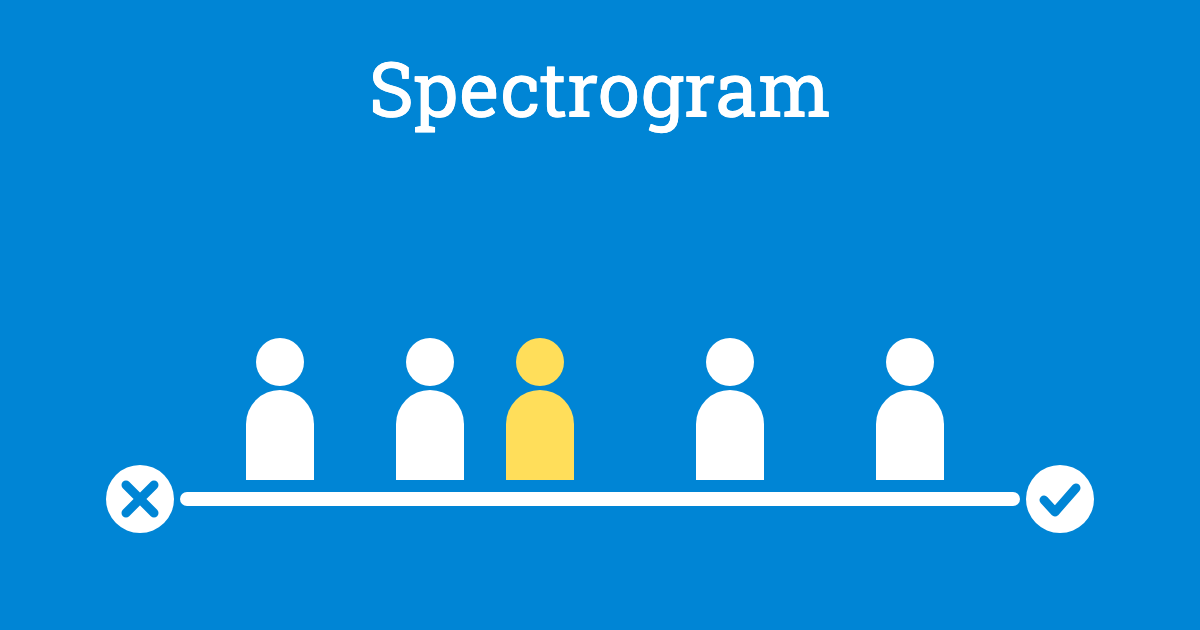
The Spectrogram turns opinions into a line across the room. You read out a statement, and everyone walks to the spot between “strongly agree” and “strongly disagree” that matches how they feel. In seconds, the whole group can see where everyone stands, and the conversation starts itself.
It’s also known as a human continuum, a values line or an opinion line. It gets people on their feet, works with any topic, and shows the range of views in a group far more honestly than a show of hands. Use light statements to warm up a group, or more serious ones to open a discussion before a decision.
Method
Mark out a line, read a statement, let people choose their spot, then ask a few people at different points along the line to explain their choice.
Step 1: Set up the line
Clear a space along one wall and put a sign at each end: “Strongly agree” at one end and “Strongly disagree” at the other. A strip of masking tape on the floor helps, but it isn’t essential. Explain that the middle of the line means “not sure” or “it depends”.
Step 2: Start with something easy
Begin with one or two light statements, so people get used to moving and nobody feels exposed. For example:
- “A cup of tea is the best way to start the day.”
- “I would rather work early in the morning than late at night.”
- “I enjoy speaking in front of a group.”
Step 3: Move to the real questions
Once people are comfortable, read out statements about the topic of your workshop. Write them so that reasonable people could disagree, for example “Our team has enough time to do its job well” or “Most of our meetings could be an email”. Give people a moment to think and move.
Step 4: Hear from different points on the line
Ask two or three people at different points along the line to say, in a sentence or two, why they are standing where they are. Start with the ends, then the middle. Invite anyone to move if they hear something that changes their mind, and notice out loud when they do.
Step 5: Notice the pattern
Before moving on, describe what you see: “Most of us are towards the agree end, but there’s a group in the middle.” Take a photo, or note roughly how many people stood where, if the results will be useful later in the session.
Outcome
Everyone sees the spread of opinion in the room at once, including the quieter views. People hear the reasons behind different positions, which makes disagreement feel normal and useful, and you get a clear sense of where the group needs to spend its time.
Tips for Facilitators
- Write statements, not questions: a clear statement, such as “We should meet less often”, gives people something to agree or disagree with.
- Avoid anything too personal: people’s positions are visible to everyone, so steer clear of topics where taking a stand could make someone feel unsafe.
- Make the middle respectable: say that standing in the middle is a real answer, not sitting on the fence.
- Keep it moving: three to five statements is usually plenty. Stop while people are still enjoying it.
- Ask, don’t argue: your job is to draw out the reasons, not to debate them. Thank each person for sharing.
Variations
- Before and after: run the same statement at the start and the end of a session to see whether views have shifted.
- Two dimensions: use the whole room as a grid, with one statement running left to right and another running front to back.
- Into discussion: after people choose their spots, ask them to pair up with someone standing a long way from them and talk for three minutes. For a deeper conversation, follow it with a Fishbowl Discussion.
- Sticker version: if people can’t move around, draw the line on a flipchart and ask everyone to place a dot sticker on it instead, as in dot voting.
Accessibility and Online Sessions
Keep the line short and clear of obstacles so wheelchair users and people with limited mobility can join in, and read each statement out twice as well as showing it on a screen. Anyone who would rather not move can point to a spot on the line or hold up a number from one to five. Online, share a slide with a line from agree to disagree and ask everyone to drag a dot or stamp to their position on a shared whiteboard, or use a poll with a five-point scale.