Walk and Talk sends pairs out of the workshop room for a conversation on the move. Each pair takes a question, walks a set route or for a set time, and comes back with something to share. A change of scene and a bit of fresh air often unlock conversations that would stall around a table.
Walking side by side feels less intense than sitting face to face, so many people find it easier to talk openly, think aloud or discuss something difficult. It also breaks up a long day, gets people moving after lunch and gives them a proper chance to get to know someone. Walking meetings are a familiar idea in many workplaces, and the same approach works well in workshops, away days and conferences.
Method
Pair people up, give them a question and a route, send them off for a set time, then gather everyone back to share what came up.
Step 1: Plan the route
Before the session, check a route that takes roughly the time you want, such as a loop around a park, the grounds or the building. Make sure it is safe, easy to follow and has places to sit along the way. If the weather might be poor, have an indoor route ready, such as a corridor, atrium or quiet floor.
Step 2: Form pairs
Pair people with someone they don’t know well, or with someone from a different team. You can match people at random, count off around the room, or let people choose if trust in the group is still low. A group of three works for odd numbers.
Step 3: Give the question
Hand each pair a card with one or two questions, so they don’t need to remember them. Good questions are open and give both people a chance to speak. For example:
- “What has gone well for you this year, and what made it work?”
- “What is one thing from this morning that you want to act on?”
- “If you could change one thing about how we work together, what would it be?”
- “What are you curious about, and who could help you explore it?”
Step 4: Walk
Agree a clear time to be back, and ask pairs to share the time fairly. Suggest that one person talks on the way out and the other on the way back, or that they swap halfway. Remind people that silence is fine while walking, as it is often when the best thinking happens.
Step 5: Come back and share
When everyone has returned, invite each pair to share one idea, insight or question from their walk, either with the whole group or with another pair. Capture the key points on a flipchart, so the conversations feed into the rest of the session.
Outcome
People make a real connection with at least one other person and come back with fresh energy and clearer thinking. Conversations are often more honest and reflective than they would be in the room, and the group gains a set of ideas or insights to build on.
Tips for Facilitators
- Set the pace for everyone: ask pairs to walk at the pace of the slower walker. This is a conversation, not a race.
- Keep time clearly: tell people the exact time to be back and ask one person in each pair to set a phone alarm.
- Warn people in advance: mention the walk in the joining instructions, so people bring suitable shoes and a coat.
- Give permission to stop: pairs can sit on a bench and talk if they would rather, and that still counts.
- Protect privacy: make it clear that pairs choose what to share when they return, so people feel safe to speak openly.
Variations
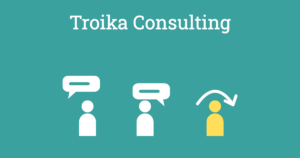
- Walking coaching: one person talks about a challenge while the other listens and asks questions, then they swap, a little like Troika Consulting for two.
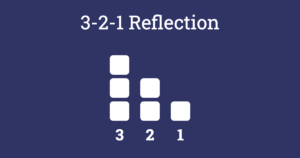
- End of day walk: use a reflection prompt such as 3-2-1 Reflection and ask each person to share one thing they will do next.
- Solo walk: send people out alone for ten minutes with a single question, then give them time for Reflective Journaling when they come back.
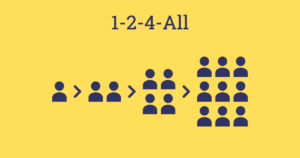
- From pairs to the room: after the walk, join pairs into fours to compare notes, then share with the whole group, as in 1-2-4-All.
Accessibility and Online Sessions
Choose a level, step-free route with somewhere to sit, and tell people the distance and the type of ground in advance. Not everyone can or wants to walk, so offer the same conversation seated in a quiet space, and make sure any route works for wheelchair users. Some people find side-by-side talking easier than eye contact, while others need to see their partner’s face to lip-read, so let pairs choose what works for them. Online, invite pairs to call each other on the phone and go for a walk in their own area, or simply to step away from the screen and talk with cameras off, then rejoin the call at a set time.