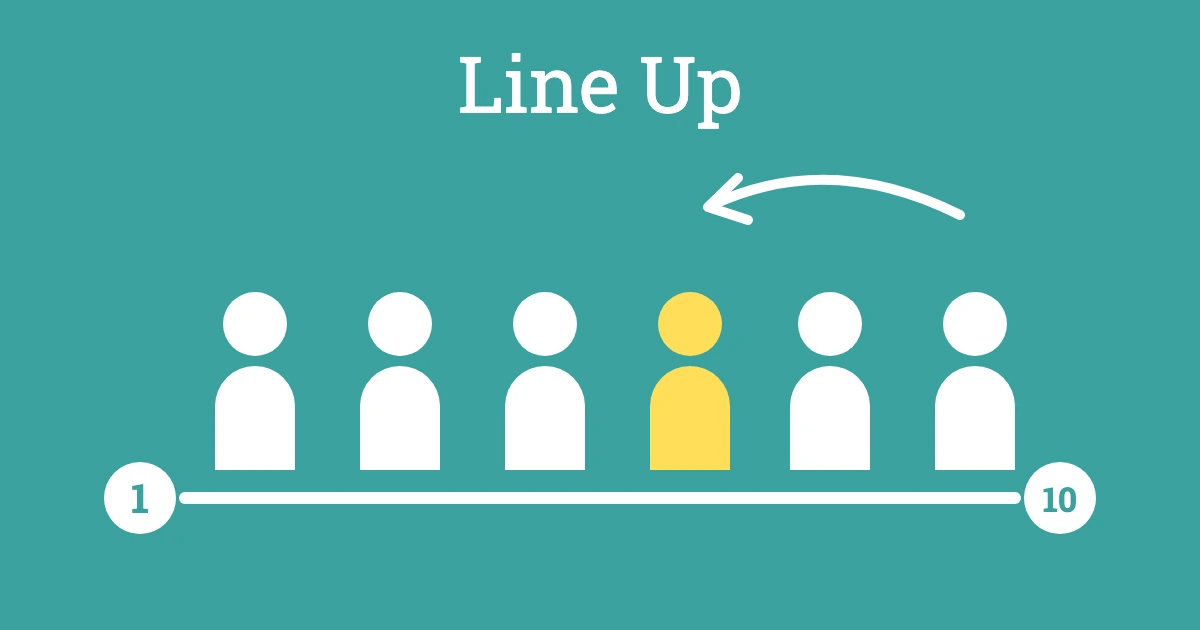
Line Up is one of the simplest icebreakers there is. You ask the group to organise themselves into a single line in order of something, such as how far they travelled to get here today, then step back while they work it out. Within a couple of minutes, everyone is on their feet, talking to people they may not have met and laughing at the results.
It’s also known as a human line-up or the line-up game. It works as an icebreaker at the start of a session, as an energiser after lunch, or as a quick way to mix people up before group work. It’s a good icebreaker because it gets people up and moving, it doesn’t take long, and nobody has to speak in front of the whole room. To find their place in the line, people have to talk to each other, so the conversation starts on its own.
Method
Show the group where each end of the line is, ask a question, and let them sort themselves into order. Check the line, then ask another question.
Step 1: Clear a space
Find a clear stretch of floor or a long wall where the whole group can stand in a row. Show where each end of the line is. A sign or a sticky note at each end helps people remember which end is which.
Step 2: Ask the first question
Read the question out and point clearly to each end as you describe it. Start with something easy and factual, for example:
“Organise yourselves in a line by how far you travelled to get here today. If it took you two minutes, stand at this end. If it took you two hours, stand at that end.”
Step 3: Let the group sort itself out
Give the group a minute or two. To find their place, people have to ask each other questions, compare answers and shuffle around. Try not to help: working it out together is the point.
Step 4: Check the line
Walk along the line and ask each person, or a few people if the group is large, to call out their answer. People enjoy the surprises, like the person who travelled for three hours or the one who checked their email ten seconds ago. Anyone in the wrong place can swap.
Step 5: Ask another question
Run two or three more rounds with different questions. Each round mixes the line up again, so people talk to someone new each time.
“Line up according to when you last checked your social media. Just now at this end, and not for days at that end.”
“Line up according to when you last checked your email. A few seconds ago at this end, and ages ago at that end.”
More questions to try
“Line up by your birthday, with January at this end and December at that end. Just the day and month, not the year!”
“Line up by what time you woke up this morning, earliest at this end and latest at that end.”
“Line up by how many cups of tea or coffee you’ve had today, none at this end and the most at that end.”
“Line up by how long you’ve worked in this field, newest at this end and longest at that end.”
“Line up in alphabetical order of your first name, A at this end and Z at that end.”
Outcome
In about ten minutes, everyone has moved around, talked to several people and learned a few small things about each other. The group is warmed up and mixed up, ready for whatever comes next, and the final line is a handy way to split people into pairs or groups.
Tips for Facilitators
- Point as you speak: say and show which end is which in every round. Most mix-ups happen because people forget which end is which.
- Keep questions light: avoid anything that ranks people by age, salary, weight or anything else they might not want to share. Travel time, daily habits and birthdays are safe choices.
- Don’t rush to help: resist sorting people yourself. The conversation they have while they work it out is what breaks the ice.
- Keep it short: two to four rounds is plenty. Stop while there’s still energy in the room.
- Use the line: once the last line is formed, split it into groups (the first five people, the next five and so on), or fold it in half to make pairs, so people work with someone new.
Variations
- Silent line-up: the group has to get into order without talking, using only gestures. It takes longer, it’s often very funny, and it works well as a teamwork energiser.
- Talk to your neighbours: once the line is formed, give people a minute to chat with the person either side of them about their answer, such as how they got here today.
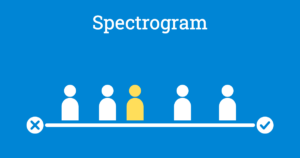
- From facts to opinions: after a couple of factual rounds, read out a statement for people to agree or disagree with instead. The line becomes a Spectrogram, and you can move into your workshop topic.
Accessibility and Online Sessions
Be mindful of anyone with limited mobility. Keep the line short, the floor clear and the pace relaxed, and give people extra time to find their place. A good way to make sure everyone is included is to let the line come to them: someone who can’t easily move can stay where they are, and everyone else arranges themselves around them. Anyone who would rather not move can tell a neighbour their answer, and the neighbour can save them a spot. Read each question out twice and show it on a screen as well, so everyone can follow it.
Online, share a whiteboard with a line across it and ask everyone to drag a sticky note with their name to their spot. In a video call, you can also ask people to type their answer in the chat, such as how many seconds it took them to get to their desk, and read out the order.