

We’ve all been there. One person holds the floor for twenty minutes. Someone else is glued to their phone. And half the room is quietly wondering whether they’re actually allowed to disagree with the boss.
Workshop ground rules won’t solve every problem, but they can stop a lot of them before they start.
And no, they’re not about treating grown adults like a class of nine-year-olds. Good ground rules are simply a shared understanding of how you’ll work together, so that people feel comfortable chipping in, asking questions and challenging ideas.
Here are twelve practical workshop ground rules to choose from, plus some tips on introducing them without your opening five minutes sounding like a health and safety briefing.
What are workshop ground rules?
Workshop ground rules are a few simple expectations about how people will talk, take part and treat each other during a session.
You’ll also hear them called group agreements, working agreements or group norms. The names are often used interchangeably, but there’s a useful difference:
- Ground rules are usually set out by the facilitator.
- Group agreements are worked out with the participants.
Seeds for Change, a UK co-operative that trains facilitators, makes the case that agreements people create together give the group more ownership, so people are more likely to stick to them.1
That said, neither approach is wrong. Some things, such as safety and treating each other with respect, aren’t up for negotiation. Plenty of others can be agreed together. Either way, the goal is the same: make expectations clear, so everyone can take part.
12 workshop ground rules worth using
Think of these as a menu, not a checklist. Pick the handful that suit your group and your topic.
1. Listen to understand
Let people finish before you jump in.
Nobody’s asking everyone to agree. The point is to listen properly, well enough to understand someone’s view before you challenge it, rather than spending their whole turn rehearsing your reply.
2. Make space for everyone
No one should have to fight for airtime.
Gently encourage the people who’ve said a lot to leave room for others. And remember that quieter people aren’t necessarily disengaged. Many would much rather share their thoughts in writing, in the chat or in a small group. Activities such as 1-2-4-All are brilliant for this.
3. Respect different opinions
Workshops often bring together people with very different backgrounds, knowledge and experiences. That’s usually the whole point.
Disagreement is absolutely fine. Personal digs, eye-rolling and mocking someone’s idea are not. Go for the idea, not the person.
4. Join in, but you can always pass
Invite everyone to take part, but make it clear that anyone can sit out an activity or skip a question.
Not everyone wants to talk about personal experiences in front of a room full of people, and nobody should feel pressured into sharing something they’d rather keep to themselves. Offering more than one way to join in makes passing far less awkward.
5. Stay on topic (mostly)
Some of the most interesting conversations are the ones that have nothing to do with why you’re all there.
Encourage people to keep things connected to the purpose of the session, and give those great-but-off-topic ideas somewhere to go. A flipchart or shared document used as a parking lot lets you capture them without derailing the agenda.
6. Be mindful of time
Start on time and finish on time, wherever you can.
This one applies to facilitators too. A ten-minute introduction that somehow stretches to half an hour eats into the conversations people actually came for. If an activity needs longer, say so, and check with the group what that means for the rest of the agenda. There are more ideas in our time management tips for facilitators.
7. Respect privacy and confidentiality
Some workshops touch on sensitive or personal subjects.
Agree what can be shared outside the room, and ask people not to repeat anyone’s personal story in a way that identifies them without permission.
But be honest with yourself and the group: an agreement can’t guarantee total confidentiality. So don’t ask people to reveal more than the session genuinely needs.
8. There’s no such thing as a silly question
Nobody should ever be made to feel daft for asking something.
Encourage curiosity and questions. If one person is confused, the odds are good that others are too and are simply too polite to say. For anyone who’d rather not ask in front of everyone, offer a way to send questions privately, such as a question box or a direct message.
9. Use technology thoughtfully
Phones and laptops aren’t automatically the enemy. People use them for notes, accessibility tools and, increasingly, for the activities themselves.
So rather than a blanket ban, agree how devices will be used. Something like “phones on silent, and step out if you need to take a call” usually does the trick. For online sessions, this is also the moment to mention muting, how to use the chat and whether the session is being recorded.
10. Challenge ideas constructively
A great workshop doesn’t need everyone to agree on everything. In fact, if they do, you might want to ask a few more questions.
Encourage people to explain why they disagree, suggest alternatives and stay open to changing their minds. A couple of handy phrases to offer the group:
“I see it a bit differently, because…”
“Could we look at another way of doing this?”
For more ways to open up a discussion, see our questioning techniques for facilitators.
11. Look after yourself
Let people know they’re welcome to grab a drink, stretch their legs, change position or step out for a moment whenever they need to. No permission slip required.
This matters most in long workshops and sessions on difficult topics. People simply think and contribute better when they’re comfortable.
12. Share responsibility for the session
The facilitator guides the process, but a workshop is only ever as good as the people in it.
Invite participants to speak up if something isn’t working, suggest ideas and help keep the group on track. The best sessions feel like everyone is facilitating a little bit.
How to agree ground rules with your group
You don’t need to spend half an hour debating every word. For a short workshop, this five-minute approach works well:
- Show three or four essential expectations on a slide or flipchart.
- Explain briefly why each one matters.
- Ask: “What else would help us work well together today?”
- Collect suggestions out loud, in the chat or on sticky notes.
- Agree the final wording, and keep it somewhere everyone can see it.
For longer workshops, ongoing groups or sessions where difficult decisions or sensitive subjects are on the table, give it more time. Seeds for Change suggests allowing at least 45 minutes to create a full group agreement from scratch, so plan it into your agenda rather than squeezing it in.
A simple script for introducing ground rules
Here’s one way to bring them up without sounding like you’re reading the terms and conditions:
“Before we dive in, I’d love us to agree how we’ll work together today. To get us started, I’d suggest three things: we respect different opinions, we make space for everyone, and everyone gets to choose how they take part. Is there anything else that would help you feel comfortable joining in?”
It’s short, it’s friendly, and it invites the group in from the very first minute, which is far more welcoming than reading out a long list of dos and don’ts.
What if someone breaks a ground rule?
It will happen. Usually, a light touch is all you need.
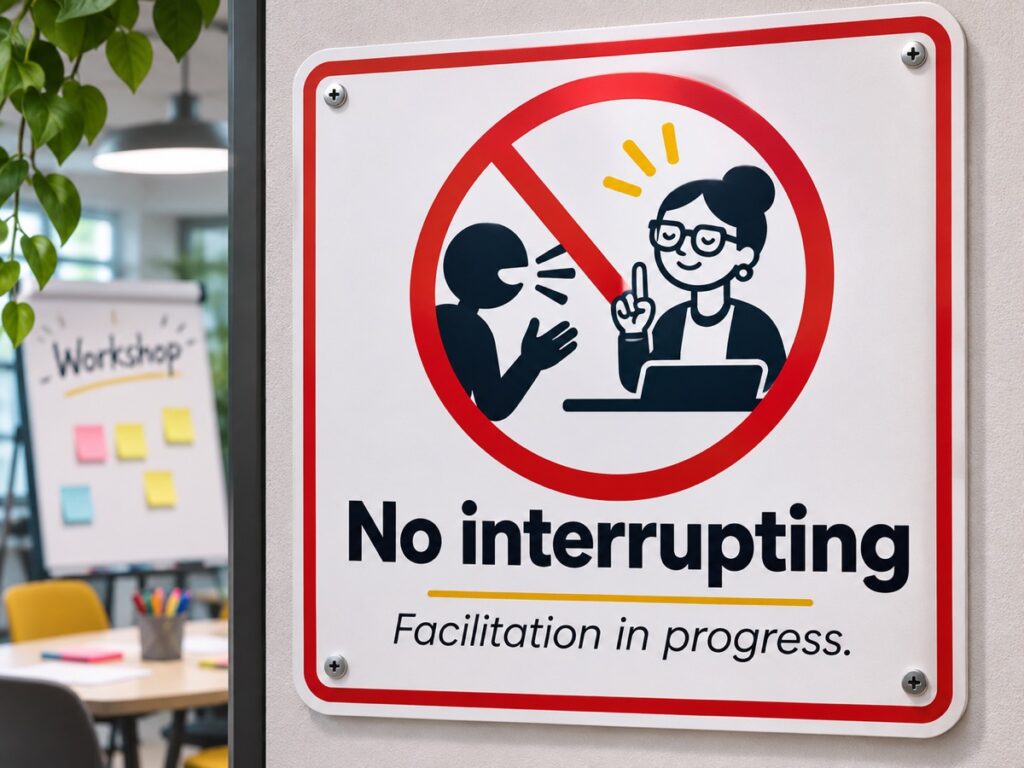
If someone keeps interrupting, for example, you could say:
“I’m going to pause us there, so we can hear from a few people who haven’t had a chance to speak yet.”
Pointing to the agreement on the wall helps too, because it’s about what the group agreed, not about you telling someone off.
If the behaviour carries on, be more direct, ideally in a quiet word during a break. And anything involving harassment, discrimination or safety needs dealing with straight away, not another gentle reminder.
Ground rules only mean something if you’re willing to stand by them, fairly and for everyone.
Ground rules for online workshops
Most of the same principles work online, but there are a few extra things worth agreeing up front:
- Whether cameras are optional
- How people can ask questions
- When to use the chat and when to use the raise-hand button
- Whether the session is being recorded
- How to ask for help privately
- What to do if someone’s connection drops
For other practical bits to cover at the start of any session, see our meeting housekeeping checklist, and for online sessions in particular, our facilitation techniques to use on Zoom.
Frequently asked questions
How many ground rules should a workshop have?
Usually four to six. A handful of clear agreements that everyone understands is far easier to remember than a long list. The twelve in this article are options to choose from, not a checklist every group has to adopt.
Should workshop ground rules be compulsory?
Some should be. Expectations around safety, respect and non-discrimination need to be clear requirements. Others can be developed with the group so they suit the people in the room.
What’s the difference between ground rules and housekeeping?
Housekeeping covers the practical side of a session, such as breaks, toilets, fire exits and the agenda. Ground rules are about how people interact and take part while the workshop is running.
When should I introduce ground rules?
Near the start, once people have arrived and settled, and before any discussion that might get lively. Keep them visible throughout the session, so you and the group can point back to them if needed.
Final thoughts
The best workshop ground rules are clear, proportionate and actually useful.
You don’t need everyone to sign up to a dozen rules. Start with the essentials, invite the group to add what matters to them, and make sure the agreements match how you really run your sessions.
Ground rules aren’t about controlling the group. They’re about creating the conditions for better conversations.
Sources
- Seeds for Change: Group agreements. How to create ground rules together with a group, and why it gives people more ownership. ↩︎