

You’ve planned your workshop, prepared the activities and guided everyone through some productive discussions. The energy has been good, people have shared ideas, and you’re pleased with how things have gone.
Then you glance at the clock.
There are five minutes left, half the group is packing away their belongings, and you haven’t discussed what happens next.
Knowing how to end a workshop is just as important as knowing how to begin one. A good closing activity helps participants reflect on what they’ve achieved, clarify decisions and leave with a sense of purpose.
It doesn’t need to be elaborate. Sometimes a simple question or a five-minute reflection is enough.
Here are nine practical workshop closing activities, along with a ready-to-use ten-minute plan for wrapping up your next session.
Why is the end of a workshop so important?
Think about the last workshop you attended.
Can you remember everything that was discussed? Probably not. But you might remember an interesting conversation, a particular activity or something you decided to do afterwards.
A thoughtful ending gives participants an opportunity to make sense of their experience rather than rushing straight back into everyday life.
It also gives the facilitator a chance to check whether the workshop achieved its purpose.
A useful closing should address three questions:
- What happened? What did we discuss, learn, create or decide?
- What does it mean? Which ideas or insights are important?
- What happens next? Are there actions, responsibilities or follow-up conversations?
Not every workshop needs a formal action plan. A creative workshop, for example, might end with participants sharing what they’ve made. A training session could finish with a reflection on learning.
The important thing is to choose a closing activity that fits the purpose of the session.
9 workshop closing activities worth trying
These activities work in different settings, from team meetings and training sessions to community workshops and collaborative planning events.
Most require little preparation and can be adapted for online or face-to-face facilitation.
1. The One-Word Check-Out
Time: 3–5 minutes
Best for: Small groups, reflective sessions and informal workshops
Materials: None
This is one of the simplest ways to finish a workshop.1
Ask each participant to share one word describing how they’re feeling or what they’re taking away from the session.
You might ask:
- What’s one word that sums up today’s workshop?
- How are you feeling as we finish?
- What word best describes what you’ve learned?
Go around the room, inviting everyone to contribute.
You might hear responses such as motivated, curious, challenged, hopeful or even confused.
Don’t assume everyone will give a positive response. That’s not the point.
The activity provides a quick impression of the group’s experience and gives people an opportunity to acknowledge how they’re leaving the session.
Facilitator tip: Allow participants to pass. If someone wants to explain their word, that’s fine, but avoid turning a quick check-out into another lengthy discussion.
For larger groups, invite people to submit their words using an online word cloud or write them on sticky notes.
One-Word Check-Out: details
- Group size: 3-20
- Duration: 3-5 minutes
- Difficulty: Easy
What you’ll need:
- Sticky notes and pens for larger groups (optional)
- An online word cloud tool (optional)
2. One Thing I’ll Do Differently
Time: 5–7 minutes
Best for: Training, professional development and skills workshops
Materials: Sticky notes, paper or a digital whiteboard
This activity encourages participants to connect their learning to something practical.
Ask everyone to complete the sentence:
“One thing I’ll do differently after today is…”
Give them a couple of minutes to think and write down their answer.
For example, someone attending a facilitation training workshop might write:
“I’ll start giving participants two minutes to think before asking for responses in group discussions.”
That’s more useful than simply saying they’ll try to be a better facilitator.
If time allows, invite participants to share their intentions with a partner.
You can also ask them to identify when they’ll put their idea into practice.
Facilitator tip: Encourage specific, realistic commitments rather than ambitious promises. One small change that someone can genuinely implement is more useful than a long list of intentions.
One Thing I’ll Do Differently: details
- Group size: 2+
- Duration: 5-7 minutes
- Difficulty: Easy
What you’ll need:
- Sticky notes, index cards or paper
- Pens
- A digital whiteboard for online sessions (optional)
3. The 3-2-1 Reflection
Time: 5–10 minutes
Best for: Learning workshops, team development and training
Materials: Paper, pens or an online form
The 3-2-1 Reflection gives participants a simple structure for reviewing what they’ve learned.
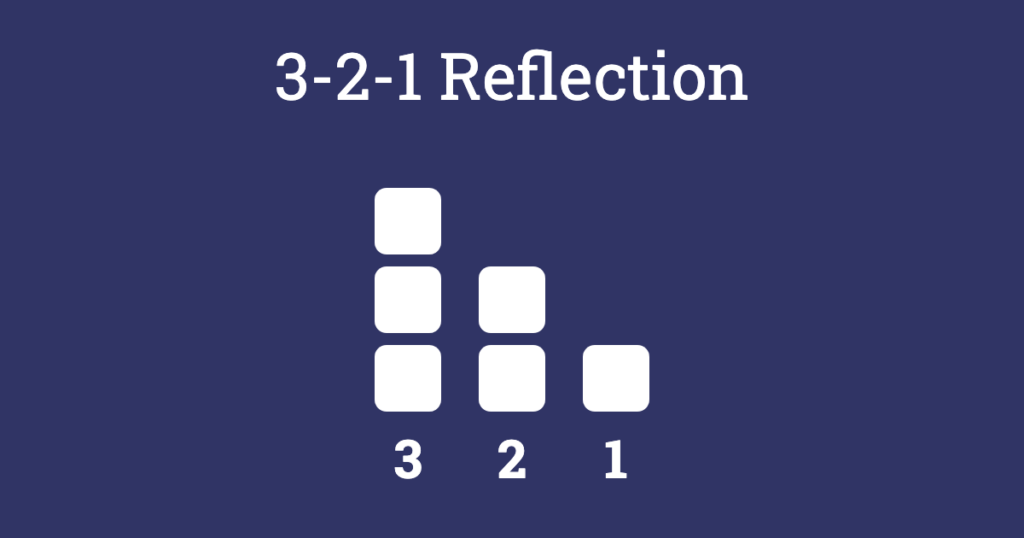
Ask them to record:
- 3 things they learned or found interesting.
- 2 things they’d like to explore further.
- 1 thing they’ll take away or put into practice.
Allow a few minutes for individual reflection before inviting people to share selected responses.
For example, after a workshop on effective meetings, someone might identify three useful facilitation techniques, two questions about applying them and one approach they want to try with their team.
You don’t have to collect everyone’s answers. Participants can keep their reflections as a personal reminder.
Alternatively, collect them with permission to identify topics that might need further explanation.
Facilitator tip: Adjust the prompts to suit your workshop. For a planning session, you could ask for three priorities, two potential obstacles and one immediate next step.
If you’re interested in developing your own practice, our guide to Reflective Practice for Facilitators explores ways to learn from the sessions you deliver.
3-2-1 Reflection: details
- Group size: 2+
- Duration: 5-10 minutes
- Difficulty: Easy
What you’ll need:
- Paper or index cards
- Pens
- A printed 3-2-1 template (optional)
- An online form for remote groups (optional)
4. The Exit Ticket
Time: 3–5 minutes
Best for: Training, large groups and workshops requiring feedback
Materials: Small cards or a digital survey
An exit ticket is a short response that participants complete before leaving.
Rather than asking everyone to give verbal feedback, you invite them to answer one or two focused questions.
For example:
- What’s the most useful thing you learned today?
- What’s still unclear?
- What could we improve about this workshop?
Participants write their responses on cards, sticky notes or a digital form.
You can collect the responses anonymously if that’s appropriate.
Exit tickets are particularly useful when you want feedback from people who may not feel comfortable speaking in front of the group.
They also provide information you can use when planning future sessions.
Facilitator tip: Keep the questions short and avoid collecting feedback you’re unlikely to use. If participants highlight an important issue, consider how you’ll respond or follow up.
The Facilitation Hub also has a collection of participative evaluation tools for gathering more detailed feedback.
Exit Ticket: details
- Group size: 5+
- Duration: 3-5 minutes
- Difficulty: Easy
What you’ll need:
- Small cards, index cards or sticky notes
- Pens
- A box or envelope to collect the tickets (optional)
- An online form or poll for remote sessions (optional)
5. The Decisions and Actions Review
Time: 8–12 minutes
Best for: Planning workshops, strategy sessions and decision-making meetings
Materials: Whiteboard, flipchart or shared document
If your workshop was designed to produce decisions or agree on a way forward, this is probably the most important closing activity.
Before everyone leaves, review what the group has agreed.
Start by asking:
“What have we actually decided today?”
Record the answers where everyone can see them.
Then identify any actions needed to move forward.
For each action, establish:
- What needs to happen?
- Who is responsible?
- When does it need to happen?
- How will progress be communicated?
Here’s an example of an action record from an imaginary team planning workshop:
| Action | Owner | Deadline |
|---|---|---|
| Draft a revised project timeline | Alex | Friday |
| Collect feedback from colleagues | Priya | Next Wednesday |
| Arrange the next planning meeting | Sam | Within two weeks |
Keep decisions separate from proposals that haven’t yet been agreed.
If something remains unresolved, record that honestly rather than presenting it as a decision.
Facilitator tip: Allow participants to check the wording of important decisions before the session ends. A few minutes of clarification can prevent confusion afterwards.
It’s also worth reviewing anything added to the Parking Lot during the workshop, so outstanding questions aren’t forgotten.
Decisions and Actions Review: details
- Group size: 3+
- Duration: 8-12 minutes
- Difficulty: Intermediate
What you’ll need:
- A whiteboard, flip chart or shared document
- Marker pens
- An action table with columns for the action, owner and deadline
6. Start, Stop, Continue
If your workshop is part of a project, a programme or a regular team meeting, Start, Stop, Continue is a quick way to review how things are going and agree what to change. The group shares what it should start doing, stop doing and keep doing, then picks two or three actions to take forward. It’s especially useful when you want the closing to feed straight into the next session.
Start, Stop, Continue: details
- Group size: 3+
- Duration: 15-30 minutes
- Difficulty: Easy
What you’ll need:
- Three flip chart sheets, or a whiteboard split into three columns
- Sticky notes
- Marker pens
- Dot stickers for prioritising (optional)
7. Evaluation Valerie
Evaluation Valerie makes feedback more playful. Participants stick notes on a drawing of Valerie: her heart for what they loved, her handbag for what they’ll take away, her bin for what didn’t help and her magic wand for one thing they’d change. It gathers richer feedback than a rating scale, and the handbag gives everyone a natural moment to name their own takeaway.

Evaluation Valerie: details
- Group size: 3+
- Duration: 5-10 minutes
- Difficulty: Easy
What you’ll need:
- Flipchart paper
- Post-it notes
- Pens
8. The Evaluation Target
When you need a snapshot of how people feel in seconds, try the Evaluation Target. As people leave, they put a sticker on a printed target: the closer to the centre, the more satisfied they are. Divide the target into sections and you can rate several parts of the session at once, such as the content, the pace and the venue.

Evaluation Target: details
- Group size: 5+
- Duration: 2-5 minutes
- Difficulty: Easy
What you’ll need:
- Large paper printout of a target, or a target drawn on a large sheet of paper
- Colourful stickers
9. The Evaluation Thermometer
The Evaluation Thermometer works in a similar way, with participants placing a sticker on a printed thermometer to show how ‘hot’ or ‘cold’ they feel.
It’s ideal for a single question, and you can make that question about action rather than enjoyment, for example ‘How confident do you feel about putting today’s ideas into practice?’. A cluster of cold stickers tells you where to focus your follow-up.

The Evaluation Thermometer: details
- Group size: 5+
- Duration: 5 Minutes
- Difficulty: Easy
What you’ll need:
- Large pre-printed thermometers on A2 paper or larger
- Stickers
How to close a workshop in just 10 minutes
What if you haven’t got time for a full closing exercise?
You can still finish meaningfully.
Here’s a simple ten-minute structure that works particularly well for a workshop focused on discussion, planning or problem-solving.
| Time | Activity | Purpose |
|---|---|---|
| Minutes 1–3 | Summarise the main outcomes | Confirm what the group achieved |
| Minutes 4–6 | Review decisions and next steps | Clarify responsibilities |
| Minutes 7–9 | Ask for one takeaway | Encourage reflection |
| Minute 10 | Explain follow-up and thank participants | Provide a clear ending |
You can adapt this to suit your session.
For a training workshop, spend more time on reflection and less on action planning. For a decision-making workshop, prioritise confirming decisions and responsibilities.
The key is to protect the closing time in your agenda.
Don’t wait until you’ve finished every other activity to see how many minutes remain.
If your workshop is running late, shorten an earlier discussion rather than automatically sacrificing the ending.
Common mistakes when ending a workshop
Even experienced facilitators occasionally rush the final few minutes.
Here are some things worth avoiding.
Introducing a completely new topic
The closing isn’t the ideal moment to open a major discussion that you don’t have time to finish.
If an important issue arises, acknowledge it and agree how it will be addressed.
Asking “Any questions?” and leaving it there
There’s nothing wrong with inviting questions, but it isn’t always a meaningful conclusion.
Participants may need time to process what happened before they know what to ask.
A focused reflection question usually gives you more useful information.
Making everyone speak
A closing round can work beautifully with a small, comfortable group.
But requiring every participant to speak publicly isn’t always appropriate, particularly after sensitive conversations or in larger groups.
Allow people to contribute in writing or pass if they prefer.
Ending without explaining what happens next
This is particularly frustrating in consultation and planning workshops.
Participants have invested their time and shared ideas. They deserve to understand how those contributions will be used.2
If decisions will be made elsewhere, explain who will make them and when participants can expect an update.
What should you do after the workshop?
A good ending doesn’t necessarily mean your work as a facilitator is finished.
Depending on the workshop’s purpose, there may be some important follow-up tasks.
Send participants a concise summary of what happened, ideally within a day or two while the discussion is fresh.
For a planning workshop, that might include decisions, agreed actions, owners, deadlines and unresolved questions.3
For a learning workshop, share any promised resources and remind participants where they can find further information.
If you collected evaluation feedback, review it and identify what you could improve.
It’s also worth spending five minutes reflecting on your own performance.
What worked particularly well? Where did the group struggle? Was the closing activity appropriate?
These small reflections can help you improve the way you design and facilitate future sessions.
Frequently asked questions
What is a good way to end a workshop?
A good workshop ending summarises what happened, gives participants an opportunity to reflect and clarifies any next steps. The right closing activity depends on the purpose of the workshop, the group and the time available.
How long should a workshop closing activity take?
Many simple closing activities take between three and ten minutes. Longer workshops, particularly those involving complex decisions, may benefit from a more substantial closing discussion. Include this time in the agenda from the beginning.
What’s the difference between a workshop closing activity and an evaluation?
A closing activity helps participants reflect, consolidate their learning or agree on next steps. An evaluation gathers feedback about the workshop’s content, process or effectiveness.
Some activities do both, but they’re not necessarily the same thing.
Final thoughts
A workshop doesn’t need a dramatic finale, an elaborate exercise or an inspirational speech.
Sometimes the most useful ending is simply giving people a few minutes to reflect on what they’ve learned.
Other times, it’s making sure everyone agrees on who is doing what next.
Whatever approach you choose, don’t treat the final few minutes as an afterthought.
Plan your workshop ending with the same care as your opening. It’s your opportunity to help people leave with clarity, purpose and something meaningful to take forward.
Sources
- Seeds for Change: Facilitation tools for meetings and workshops. Practical closing rounds, personal takeaways and evaluation methods. ↩︎
- YoungMinds: Digital Participation Toolkit (PDF). Guidance on closing participatory workshops, supporting participants and communicating follow-up. ↩︎
- WIEGO: How to Conduct an Online Participatory Evaluation Workshop (PDF). Examples of structured closing and follow-up planning. ↩︎