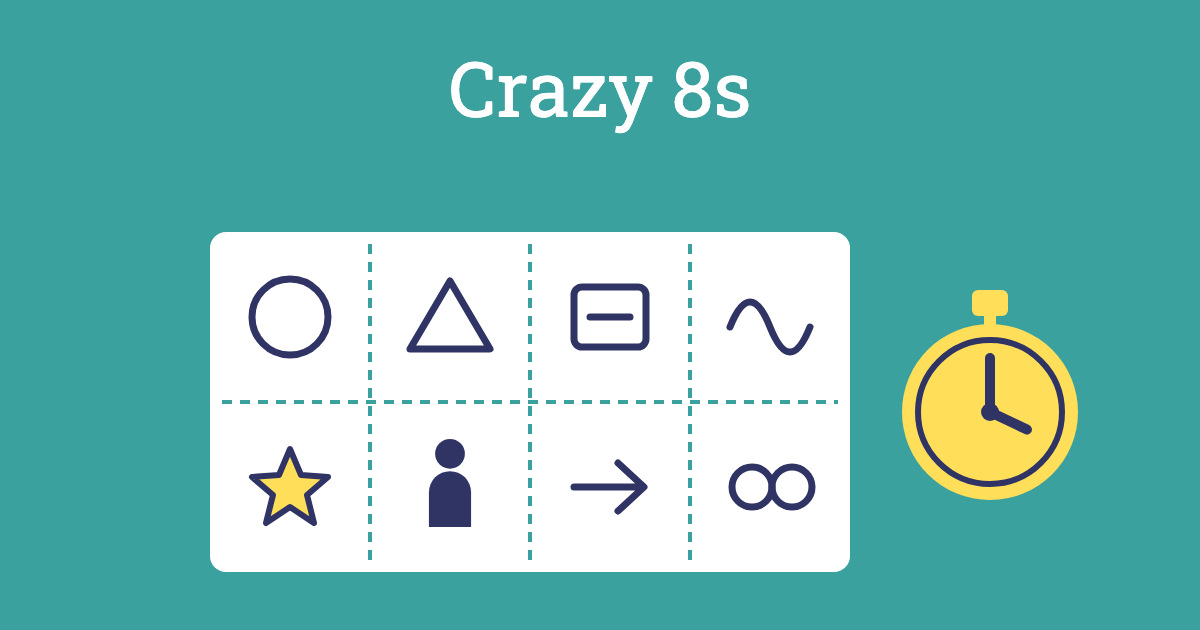
Crazy 8s asks everyone to sketch eight different ideas in eight minutes. A sheet of paper is folded into eight panels, a timer starts, and people have one minute per panel. There is no time to polish or overthink, so people quickly move past their first, most obvious idea and start to explore.
The activity is a well-known part of the design sprint process developed at Google Ventures and described in the book Sprint by Jake Knapp, John Zeratsky and Braden Kowitz. It is widely used by service design and product teams, but it works for any problem where you want a range of ideas, from redesigning a form to planning an event. Each person works alone and in silence, which gives quieter people an equal voice and avoids groupthink.
Nobody needs to be able to draw. Stick figures, boxes, arrows and a few words are all it takes, and a rough sketch often explains an idea more clearly than a long description.
Method
Agree the problem, fold the paper, sketch eight ideas against the clock, then share the sketches and choose ideas to take forward.
Step 1: Frame the challenge
Write the problem on the wall as a clear question, such as “How might we make it easier for new volunteers to find their way on their first day?”. Make sure everyone understands it, and share any research or notes the group needs before starting.
Step 2: Fold the paper
Give each person a sheet of A4. Ask them to fold it in half three times, then open it out to show eight panels. Thick marker pens help people keep their sketches simple and bold.
Step 3: Warm up
If the group is new to sketching, do a quick practice round, such as one minute to draw a cup of tea. Remind everyone that the goal is ideas, not art.
Step 4: Sketch eight ideas
Start the timer and call out each minute. People sketch one idea per panel, and every panel should be different. If someone gets stuck, suggest they draw a variation on an earlier idea, or its opposite. It’s normal for the last few panels to feel hard, and that is often where the less obvious ideas appear.
Step 5: Share the sketches
Ask each person to stick their sheet on the wall and take a minute or two to talk the group through their ideas while others listen without judging. Alternatively, ask everyone to walk around in silence and read the sketches first.
Step 6: Choose ideas to develop
Give each person a few dot stickers to vote for the ideas, or parts of ideas, that they find most promising. Pick out the most popular ones to develop further, combine or test.
Outcome
Each person generates eight ideas in eight minutes, so even a small group has dozens of options to look at. The group explores a much wider range of possibilities than an open discussion usually allows, everyone contributes equally, and the strongest ideas quickly become visible.
Tips for Facilitators
- Keep strict time: the pressure is the point. Call out each minute clearly so people move on.
- Show a rough example: share a scrappy sketch of your own, so people see that simple is fine.
- Allow words: people who feel anxious about drawing can add short labels, or write a headline in a panel.
- Quantity over quality: say clearly that half-formed or silly ideas are welcome, as they often spark better ones.
- Run it twice: after sharing, a second round lets people build on what they have seen from others.
Variations
- Crazy 4s: for groups new to sketching, fold the paper into four panels and allow two minutes each.
- One big idea: after voting, ask each person to spend ten minutes sketching their favourite idea in more detail on a single sheet.
- Bad ideas first: warm up with World’s Worst [X], then flip the worst ideas into good ones during the eight minutes.
- Sort before voting: with a large group, cluster similar sketches with Affinity Mapping, then use dot voting to choose ideas to take forward.
Accessibility and Online Sessions
Some people find drawing difficult because of a disability, an injury or anxiety, so make it clear that words, symbols or a quick list are just as welcome. Allow extra time per panel, or fewer panels, for anyone who needs it, and avoid drawing attention to slower sketchers. Describe the sketches aloud during sharing for people with sight loss. Online, ask people to sketch on paper and hold it up to their camera, or photograph it and upload it to a shared whiteboard, or use the whiteboard’s own drawing tools with a grid of eight frames.