Troika Consulting gives everyone in the room a chance to get advice on a real challenge from two of their peers. In groups of three, one person explains their challenge, then turns their back while the other two discuss it as if they weren’t there. It’s quick, surprisingly powerful, and builds trust fast.
Troika Consulting is one of the Liberating Structures created by Henri Lipmanowicz and Keith McCandless. Turning away is the clever part. The person with the challenge can’t jump in to explain or defend themselves, so they simply listen, and the consultants feel free to say what they really think. It works well in team days, leadership programmes, peer support groups and networking events.
Method
Form groups of three. Each person takes a turn as the client, with the other two as consultants. Each round takes about 10 minutes.
Step 1: Prepare a challenge
Give everyone two minutes to think of a real challenge they are facing, and to frame it as a question, such as “How can I get my team to speak up more in meetings?”. It should be something they have some control over and would welcome help with.
Step 2: The client shares the challenge (2 minutes)
The first client explains their challenge and what kind of help they would like. The consultants just listen.
Step 3: The consultants ask questions (2 minutes)
The consultants ask questions to understand the challenge better. These should be genuine questions, not advice in disguise.
Step 4: The client turns around (4 to 5 minutes)
The client turns their chair to face away from the others, and takes notes if they like. The consultants talk to each other about the challenge: what they notice, what might be going on, and ideas or advice they would offer. The client stays silent throughout.
Step 5: The client turns back (2 minutes)
The client turns round and tells the consultants what was most useful, and what they might do next. It’s not the time to explain why the consultants got something wrong.
Step 6: Swap roles
Repeat the round until everyone in the group has been the client. Then bring the whole room back together for a few minutes to share what people noticed about the process.
Outcome
Everyone leaves with new ideas about a challenge that matters to them, and the experience of helping two other people with theirs. People often say that listening without being able to respond helped them hear things differently, and groups build trust and a habit of asking each other for help.
Tips for Facilitators
- Keep strict time: announce each change of step clearly and use a visible timer, so every group moves together and nobody misses their turn.
- Mix the groups: people get more original advice from colleagues who don’t work closely with them.
- Model the back turn: it can feel awkward at first, so show how to turn the chair and explain why it works.
- Encourage honesty and kindness: consultants should speak frankly but warmly, as if the client could hear every word, because they can.
- Protect confidentiality: agree at the start that what is said in each group stays there, unless the client chooses to share it.
Variations
- Quick round: for a short session, run just one round, with one volunteer client in each group.
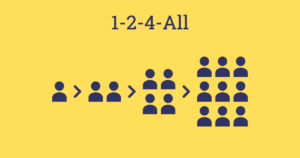
- Warm up first: use 1-2-4-All to help people find and sharpen their challenge before the troikas start.
- Dig deeper: if a challenge has several causes, the client can map it afterwards with a Problem Tree.
- Ongoing peer support: keep the same troikas for a series of sessions, so people can report back on what they tried.
Accessibility and Online Sessions
Turning away isn’t essential: the client can close their eyes, look down or simply stay silent, so anyone can take part in the way that suits them. Give out the steps and timings on a card or slide, and allow extra time for interpreters or for people who need more time to process. Online, use breakout rooms of three, and ask the client to turn off their camera and microphone while the consultants talk, then turn them back on to respond.