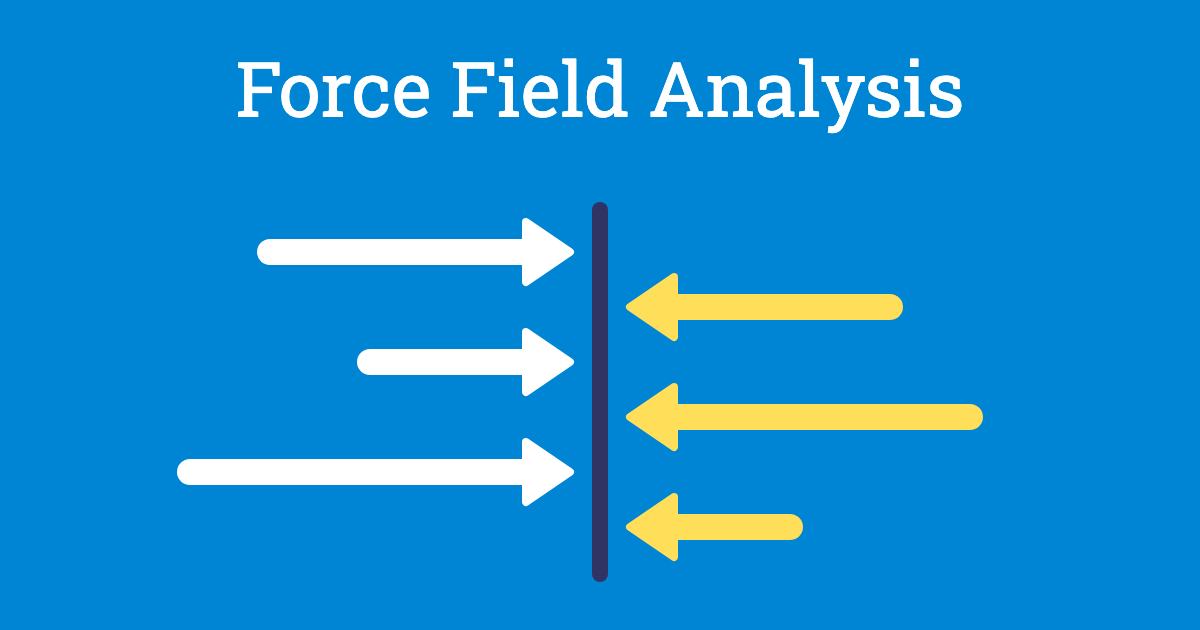
Force Field Analysis helps a group understand why a change is or isn’t happening. On one side of a line, people list the forces driving the change forward, and on the other, the forces holding it back. By scoring each force and talking it through, the group can see what needs to shift and where its effort will make the most difference.
The method comes from the social psychologist Kurt Lewin, who developed it in the 1940s as part of his work on how groups and organisations change. His insight was that a situation stays as it is while the forces for and against change are roughly balanced. To move things on, you can strengthen the driving forces, but reducing the restraining forces is often more effective and creates less resistance.
It works for almost any change, from introducing a new system at work to getting more people to use a community service, and it’s especially useful when a group feels stuck.
Method
Describe the change, list the driving and restraining forces, score their strength, explore the strongest ones, then plan actions to tip the balance.
Step 1: Describe the change
Write the change you want in a box at the top of a large sheet, for example “More residents report repairs online”. Underneath, briefly describe how things are now. Draw a vertical line down the middle of the sheet, below the box.
Step 2: List the driving forces
On the left, list everything pushing towards the change, one per sticky note in one colour. Prompt people to think about people, money, time, rules, technology, culture and outside pressures. For example, “Staff want fewer phone calls” or “Many residents already use apps for other services”.
Step 3: List the restraining forces
On the right, in a second colour, list everything holding the change back, such as “Some residents have no internet access” or “The form asks for a reference number people don’t have”. Encourage honesty, as this is where the most useful insights usually come from.
Step 4: Score the forces
Score each force from one (weak) to five (strong). Discuss the scores as a group, or ask everyone to score on their own and take an average. Draw an arrow for each force pointing at the middle line, with its length showing its strength, and add up the totals on each side.
Step 5: Explore the strongest forces
Look at the biggest arrows on each side. For the restraining forces, ask why they exist and what lies behind them. A few rounds of The ‘Why’ Game can help get to the root of a barrier.
Step 6: Plan actions
For each important force, agree actions that would strengthen a driver, reduce a barrier or remove it completely. Focus on the barriers first, as pushing harder against strong resistance often makes it stronger. Agree who will do what, and by when.
Outcome
The group shares a clear picture of what is helping and hindering a change, with an honest view of how strong each force is. Instead of pushing harder in the same direction, people leave with practical actions aimed at the barriers that matter most.
Tips for Facilitators
- Make the change specific: a vague goal such as “better communication” leads to vague forces. Describe what will be different when the change has happened.
- Include feelings: worry, habit and trust are real forces. Make it safe to name them alongside money and systems.
- Don’t argue about scores: the numbers are rough estimates to guide discussion. If people disagree strongly, talk about why.
- Bring in other views: the people affected by a change often see restraining forces that planners miss, so involve them if you can.
- Look for quick wins: some barriers are easy to remove, such as a confusing instruction or a missing link. Start there to build momentum.
Variations
- Personal force field: use the same method on your own for a personal goal, such as starting a new habit, and pair it with the Circle of Influence to see which forces you can act on.
- Prioritise actions: plot the actions on an Impact/Effort Matrix to decide which to tackle first.
- Find causes first: use The Problem Tree to understand a problem, then Force Field Analysis to plan the change.
- Test the plan: follow up with a Pre-Mortem to check what could still stop the change from happening.
Accessibility and Online Sessions
Use high-contrast colours for the two sides, but don’t rely on colour alone: label the columns “Driving” and “Restraining” clearly. Read the forces and scores aloud as the chart develops. Offer scoring on paper or by holding up fingers for anyone who finds it hard to reach the wall. Online, prepare a template on a digital whiteboard with two columns and space for arrows, ask people to add notes in silence first, and use a poll or a simple table for scoring.