
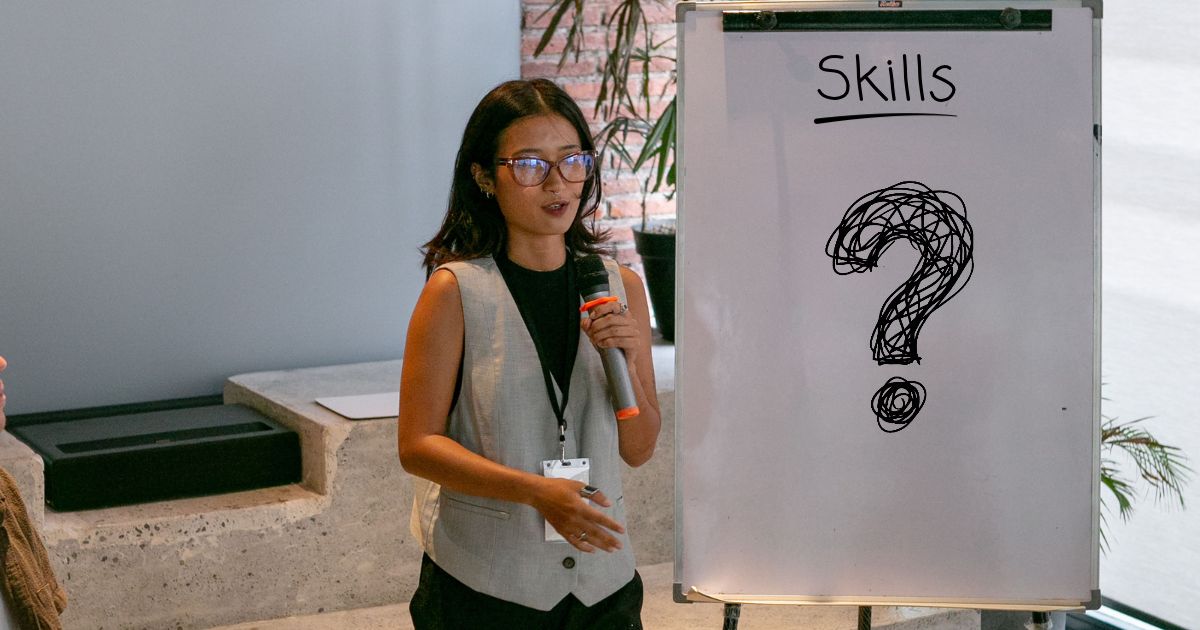
Watch a good facilitator at work and it can look effortless. People talk, ideas flow, the group reaches a decision and everyone leaves on time.
It isn’t effortless, of course. Behind that calm session is a set of skills the facilitator has practised, often for years.
The good news is that skills can be learned. You don’t need to be a born extrovert or a natural leader to facilitate well. You need to know what the job asks of you, and then practise it.
This guide covers the 12 essential facilitation skills every facilitator needs, what each one looks like in a real session, and the personal qualities that help you use them well.
What does a facilitator need to be able to do?
A facilitator’s job is to help a group do its best thinking and reach its goals. You look after the process, so the group can concentrate on the content.
The International Association of Facilitators (IAF) groups the work into six core competencies, which also form the basis of its Certified Professional Facilitator assessment:1
- Creating collaborative client relationships
- Planning appropriate group processes
- Creating and sustaining a participatory environment
- Guiding the group to appropriate and useful outcomes
- Building and maintaining professional knowledge
- Modelling a positive professional attitude
Those headings are useful, but they’re quite broad. In practice, they break down into a handful of everyday skills you’ll use in almost every session.
Skills or qualities: what’s the difference?
Lists of facilitation skills often mix two different things together.
A skill is something you do. You can practise it, get feedback on it and improve it. Summarising a discussion is a skill. So is keeping to time.
A quality is part of who you are: your values, your temperament and how you see other people. Patience and curiosity are qualities.
The line isn’t always neat. Nearly everything can be developed with effort. But it’s a useful distinction, because it tells you where to put your energy. You can’t train yourself to be curious in an afternoon, but you can learn to ask better questions by Friday.
Impartiality is a good example. Nobody is truly impartial. Everyone has opinions. What a facilitator does is demonstrate impartiality, and that’s a skill you can learn.
We’ll start with the skills, then look at the qualities that help.
12 essential facilitation skills
1. Active listening
Active listening means giving someone your full attention and showing them you’ve understood. It’s the skill every other facilitation skill depends on.
It sounds simple, but it’s hard to do while you’re also watching the clock, planning the next activity and keeping an eye on the rest of the room.
In practice, active listening looks like this:
- Letting people finish before you respond
- Reflecting back what you heard, in their words rather than yours
- Checking you’ve understood: “So the main worry is the timescale, not the budget?”
- Noticing what isn’t being said, as well as what is
When people feel heard, they’re far more willing to listen to each other.
2. Clear communication and instructions
Most activities that go wrong do so in the first minute, because the group didn’t understand what they were meant to do.
Good facilitators give short, simple instructions in a sensible order. They explain the purpose of an activity, what people will do, how long they have and what they’ll produce at the end.
A few habits help:
- Give one instruction at a time, and pause between them
- Put the instructions on a slide or flipchart, so nobody has to remember them
- Ask “What questions do you have?” rather than “Any questions?”
- Avoid jargon, or explain it the first time you use it
Clear communication also covers the practical bits at the start of a session, such as breaks, timings and how the group will work together. Our guide to housekeeping for meetings covers what to include.
3. Reading the room
Reading the room means picking up on how the group is feeling, often before anyone says so. Much of that comes from nonverbal cues: body language, facial expressions, tone of voice, energy levels and silence.

You might notice that:
- People have stopped making eye contact and started checking their phones
- One person keeps starting to speak, then stopping
- The room went quiet after a particular comment
- Arms are folded and chairs are pushed back from the table
Treat these cues as questions, not answers. Folded arms might mean someone disagrees, or it might mean the room is cold. The skill is noticing the cue, then checking: “I’m sensing some hesitation. What’s on people’s minds?”
You may have heard that 93% of communication is nonverbal. That’s a myth. The figure comes from Albert Mehrabian’s experiments in the 1960s, which looked only at how people communicate feelings and attitudes. Mehrabian himself says the numbers don’t apply unless someone is talking about their feelings or attitudes.2 Nonverbal cues matter, but words still matter too.
4. Asking good questions
Facilitators work mostly through questions. A good question can open up a stuck discussion, bring in a quiet voice or help a group see a problem differently.

Open questions usually work best, because they invite people to think rather than just agree or disagree:
“What would need to be true for this to work?”
“What are we not talking about yet?”
“Who hasn’t had a chance to share their view?”
Just as important is what you do after asking: wait. Silence feels much longer to the facilitator than it does to the group. Count to ten before you rephrase or answer your own question.
For more on this, see our guide to effective questioning techniques for facilitators.
5. Demonstrating impartiality
A facilitator is meant to be neutral on the content of a discussion. But you’re human. You’ll have views on the topic, you’ll find some ideas more convincing than others, and you might even like some participants more than others.
Demonstrating impartiality isn’t about having no opinions. It’s about making sure your opinions don’t steer the group. That takes practice.
Seeds for Change, a UK co-operative that trains facilitators, suggests making it clear when you’re giving your own opinion rather than acting as the facilitator, and stepping out of the role altogether if you want to take part in the discussion.3
Impartiality shows up in small things:
- Writing every idea on the flipchart in the words people used, not a tidier version of the ones you prefer
- Responding to every contribution in the same tone, whether you agree with it or not
- Giving equal time to each option before the group decides
- Watching your face when someone says something you disagree with
If you have a strong stake in the outcome, such as when you’re facilitating your own team’s meeting, say so openly, or ask someone else to facilitate that item.
6. Designing and planning sessions
Much of a facilitator’s work happens before anyone enters the room.
Planning starts with purpose. What does the group need to leave with: a decision, a list of ideas, a shared understanding, a plan? Once you know that, you can choose activities that lead there, in an order that makes sense.
A well-designed session usually moves through three stages: opening up the topic, exploring it, then narrowing down towards a conclusion. Tools such as 1-2-4-All help with exploring, while dot voting helps with narrowing down.
Planning also means agreeing the purpose with whoever asked you to facilitate, checking the room, and preparing your materials. Our facilitator’s kit bag list will help with the last part.
7. Managing time
Time management is one of the most visible facilitation skills. Groups notice when a session overruns, and they notice when the most important item gets squeezed into the last five minutes.

Keeping to time isn’t about rushing people. It’s about making conscious choices. If a discussion is valuable and running over, you can ask the group whether to continue and what to drop instead.
Build buffer time into your plan, give people a warning before an activity ends, and use a parking lot for useful points that don’t fit today. There’s more in our time management tips for facilitators.
8. Creating a safe, inclusive environment
People only share honest views, half-formed ideas and mistakes when they feel it’s safe to do so.

Amy Edmondson, a professor at Harvard Business School, calls this psychological safety: a shared belief within a team that it’s safe to take interpersonal risks. Her 1999 study of 51 work teams found that psychological safety was linked to learning behaviour, such as asking for help and discussing errors, which in turn was linked to how well teams performed.4
As a facilitator, you can build that safety in practical ways:
- Agree a few ground rules with the group at the start
- Thank people for contributions, especially uncomfortable ones
- Offer different ways to take part, such as writing, pairs or small groups, not just speaking to the whole room
- Balance the voices, so the loudest people don’t fill all the space
- Think about accessibility when you plan, not just on the day
Gentle warm-ups such as Line Up or When the Wind Blows can help a group relax at the start. Not sure whether you need one? Read are icebreakers necessary?
9. Managing group dynamics and conflict
Every group has its own dynamics. There’s often someone who talks a lot, someone who says very little, and a disagreement that’s been simmering since long before your session.

Disagreement isn’t a problem in itself. Healthy conflict often leads to better decisions. The skill is keeping it focused on ideas rather than people, and stepping in early when it starts to turn personal.
That might mean naming what’s happening, calmly and without blame:
“There are clearly strong feelings on both sides. Let’s make sure we understand each view properly before we try to settle it.”
Our guide to handling difficult participants in a workshop has practical scripts for the most common situations.
10. Summarising and helping groups decide
Groups can talk for hours without realising they’ve already agreed. A good summary helps them see where they are.
Summarising means pulling together the main points of a discussion, briefly and fairly, then checking it with the group: “It sounds like we agree on the first two options, but not the third. Is that right?”
From there, you help the group decide. Agree how the decision will be made before you make it, whether that’s consensus, a vote or the manager’s call. Then record what was decided, who will do what and by when. A decisions and actions review is a simple way to do this.
Find more ideas in how to end a workshop.
11. Adapting on the spot
No session goes exactly to plan. Half the group arrives late. An activity falls flat. The real issue turns out to be something nobody mentioned beforehand.
Experienced facilitators hold their plan loosely. They know the purpose well enough to change the route without losing sight of where the group needs to get to.
It helps to plan for this. Have a shorter version of each activity ready, know which items could be dropped, and keep a couple of reliable activities up your sleeve. If you’re unsure which way to go, ask the group. They’ll often know what they need.
12. Facilitating online
Online facilitation uses all of the skills above, but some of them become harder. Reading the room is tricky when cameras are off, and it’s easier for people to drift away into their emails.

Online facilitators need to be confident with the platform, give even clearer instructions and build in more ways to take part, such as the chat, polls, reactions and breakout rooms. Shorter sessions with more frequent breaks usually work better too.
For practical ideas, read our facilitation techniques to use on Zoom and how to monitor engagement in online workshops.
Facilitation skills at a glance
| Skill | What it looks like in practice |
|---|---|
| Active listening | Reflecting back what people said and checking you’ve understood |
| Clear communication | Short, simple instructions, written up where everyone can see them |
| Reading the room | Noticing body language and energy, then checking what it means |
| Asking good questions | Open questions, followed by time to think |
| Demonstrating impartiality | Treating every idea the same and saying when you’re sharing your own view |
| Designing sessions | Choosing activities that lead to the purpose of the session |
| Managing time | Making conscious choices about what to extend and what to drop |
| Creating a safe environment | Ground rules, different ways to take part and balanced voices |
| Managing group dynamics | Keeping disagreement focused on ideas, not people |
| Summarising and deciding | Pulling discussions together and recording decisions and actions |
| Adapting on the spot | Changing the plan while keeping the purpose in sight |
| Facilitating online | Using chat, polls and breakout rooms so everyone can take part |
Qualities that help (but aren’t skills)
Skills tell you what to do. Qualities shape how you do it.
You won’t find these on a training course, but they make a real difference to how a group responds to you:
- Curiosity: a genuine interest in what people think and why they think it
- Respect for every participant: believing everyone in the room has something worth hearing
- Confidence in the group: trusting that the group can find its own answers, rather than needing you to provide them
- Patience: giving people the time they need, even when you can see where the discussion is heading
- Empathy: being able to imagine how a session feels from someone else’s chair
- Calm under pressure: staying steady when the plan falls apart or tempers rise
- Humility: remembering that the session is about the group, not about you
- A sense of humour: a little lightness helps people relax, as long as it’s never at anyone’s expense
Don’t worry if some of these don’t come naturally. Qualities grow with experience, and practising the skills often helps. It’s much easier to stay calm when you know you can rescue a session that’s going off track.
How to develop your facilitation skills
Like any skill, facilitation improves with practice and feedback. Here are some practical ways to build yours:
- Start small: volunteer to facilitate a team meeting or a single agenda item before taking on a full workshop.
- Co-facilitate: work alongside a more experienced facilitator, and agree beforehand who leads each part.
- Watch others: when you attend a session as a participant, notice what the facilitator does and how the group responds.
- Ask for feedback: a quick exit ticket at the end of a session tells you what worked from the group’s point of view.
- Reflect afterwards: spend ten minutes after each session noting what went well and what you’d change. Our guide to reflective practice for facilitators explains how.
- Learn the theory: understanding the key concepts of facilitation helps you explain why an approach works, not just that it does.
- Consider training or certification: facilitation courses give you a safe space to practise, and the IAF’s Certified Professional Facilitator assessment is one way to have your skills formally recognised.
Pick one skill at a time to work on. Trying to improve all twelve at once in a single session is a recipe for feeling overwhelmed.
Frequently asked questions
What are the most important facilitation skills?
Active listening, clear communication, asking good questions, reading the room and demonstrating impartiality are the foundations. Planning, time management and helping groups reach decisions build on them. Most facilitators use all of these in every session.
Can facilitation skills be learned?
Yes. Facilitation skills improve with practice, feedback and reflection, just like any other skill. Many good facilitators started by running small team meetings and built up from there.
What’s the difference between facilitation skills and facilitator qualities?
A skill is something you do and can practise, such as summarising a discussion or keeping to time. A quality is part of your character, such as patience or curiosity. Both matter, but skills are usually quicker to develop.
Does a facilitator have to be neutral?
A facilitator should be neutral on the content of a discussion, but not on the process. Nobody is truly free of opinions, so the skill is in making sure your views don’t steer the group. If you want to share your opinion, say clearly that you’re stepping out of the facilitator role, or ask someone else to facilitate that part.
Do you need a qualification to be a facilitator?
No. You don’t need a formal qualification to facilitate. Many facilitators learn through practice and short courses, and some go on to professional certification, such as the International Association of Facilitators’ Certified Professional Facilitator assessment.
Final thoughts
Facilitation isn’t a talent you either have or don’t. It’s a set of skills, and every one of them can be practised.
Listening, asking good questions and staying impartial will take you a long way. Planning, time management and helping groups decide will take you further.
The qualities matter too. But they tend to grow as your confidence does.
Choose one skill to focus on in your next session. Notice how it goes, reflect on it afterwards, and build from there.
Sources
- International Association of Facilitators: The IAF Core Competencies. The six competency areas behind the IAF Certified Professional Facilitator assessment. ↩︎
- Albert Mehrabian: Silent Messages. Mehrabian explains that his figures on verbal and nonverbal communication only apply to communicating feelings and attitudes. ↩︎
- Seeds for Change: Facilitating meetings. A practical guide to the facilitator role, including staying neutral and stepping out of role. ↩︎
- Amy Edmondson, Harvard DASH: Psychological Safety and Learning Behavior in Work Teams. Administrative Science Quarterly, 1999, a study of 51 work teams. ↩︎